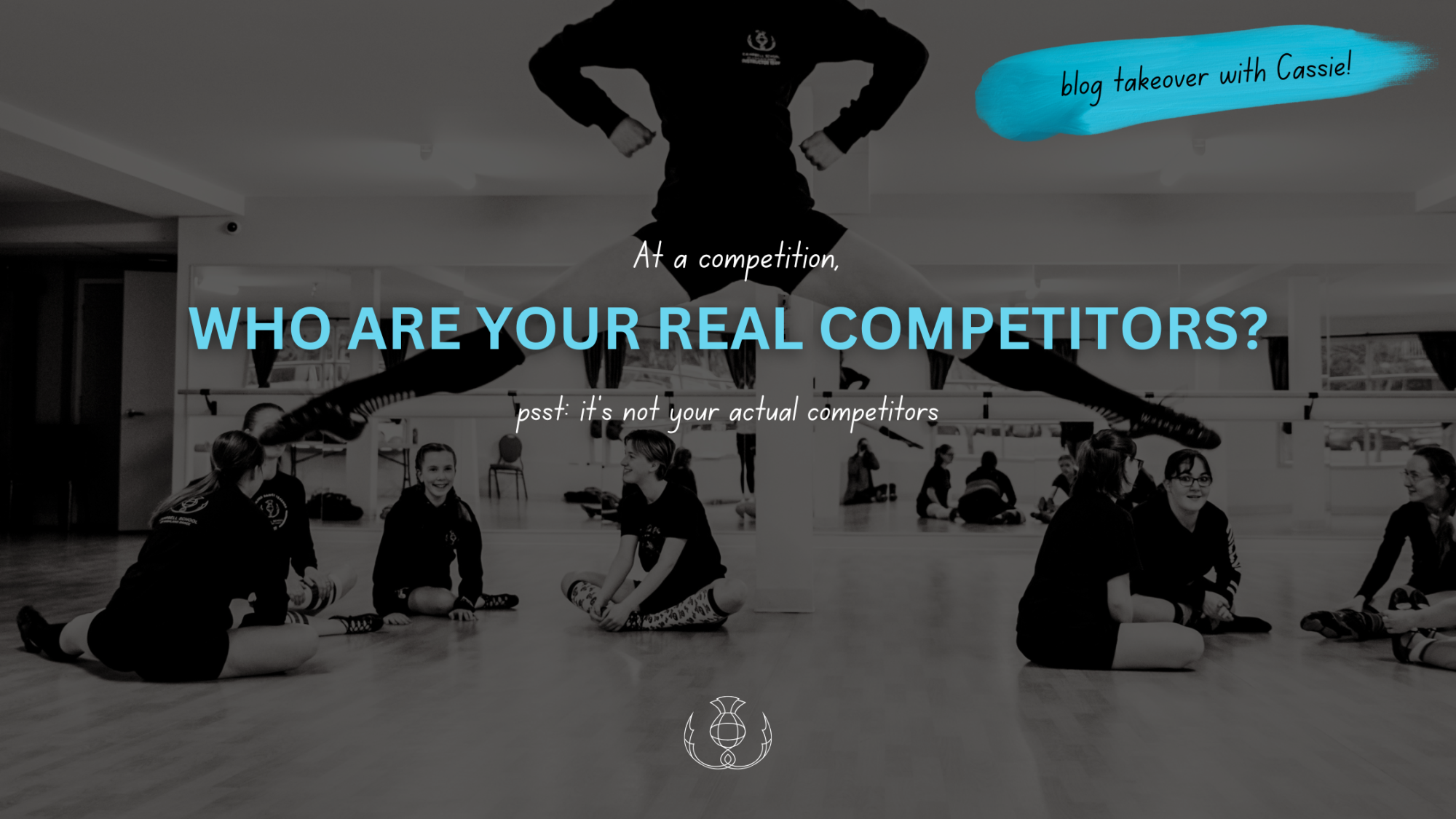
Blog Takeover with Cassie
When people hear the word competition, they often imagine rivalry, comparison, and pressure. In many activities, that can be true. Highland dance does include judges, placings, and medals, but I feel like the heart of competition looks very different than most people expect.
The most important competition in Highland dance is not against the dancer beside you. It is against who you were the last time you stepped on stage. I try to follow this philosophy as best I can, and think you should too!
This mindset is one of the reasons Highland dance can be such a positive and sustainable activity for children and teens, and why I’ve found a lot of joy in competing as an adult. For me, competition became a personal challenge rather than a constant comparison. Here is why that distinction matters so much.
You Can Only Control One Dancer
At a competition, there are many things you can’t control, and honstly, sometimes it feels like a lot. You don’t choose who shows up, You don’t control group size, experience levels, growth spurts, or how long someone else has been dancing. It sometimes is like walking into a complete unknowen.
What you can control is your own dancing. You can control how prepared you feel. You can control the effort you bring to class. You can control how consistently you practice. You can control how focused you stay on stage. So all those unknowns start to feel less important once you focus on all the things that you can manage.
Because of that, the most helpful questions are not about beating someone else. They sound more like this:
Did I dance stronger than last time
Did I apply my corrections
Did I stay calm and focused
That definition of success is fair, empowering, and far more motivating in the long run. I find that the more I focus inwardly at a competition, the more successful I feel, regardless of results.
Placings Are Information, Not a Verdict
Every dancer experiences moments that feel confusing or frustrating, especially with results. Sometimes a dancer performs beautifully and places lower than expected, or on the other side, a dance feels shaky and still results in a medal. I know first-hand how frustrating those moments can be.
What really helps me is to remember that placings are influenced by many factors. Judge preference, group size, and timing all play a role, but really dance is a snapshot of a single moment, not a full picture of potential or dedication.
Because of that, I try to focus more on progress than on results from one competition.
Progress might look like a cleaner second step in the Sword. It might be a stronger championship Fling. It might be walking on stage with more confidence or recovering calmly after a mistake. Those moments are the real growth, whether or not they come with a medal and they are what I thin contribute to the amazing people Highland Dance produces.
Comparison Steals Joy and Confidence
It is natural for dancers to notice the same faces at competitions, and to start having feelings about dancers that usually place better or worse than them. Comparison can creep in quietly and begin to shape how dancers see themselves.
Comparison often tells dancers that someone else succeeding means they are failing. It suggests that faster progress equals more worth. It can convince dancers that one tough day defines them.
That way of thinking is not accurate and it is not helpful and definitely held me back competitively. I’ve had to work hard to move on from that mindset, but the work has been well worth it.
Highland dance is not a limited resource. One dancer placing well does not take anything away from another and there’s room for many dancers to succeed in different ways and on different timelines.
Progress Is Not Linear or Synchronized
No two dancers develop at the same pace, which is obvious when you say it, but harder to keep in mind when you’re at a competition.
Some dancers gain strength quickly but need time to build stamina. Others have beautiful musicality but need patience with technique. Growth spurts can temporarily change everything.
When dancers focus only on others, all of that context disappears. Suddenly all your own circumstances feel overwhelming when the other dancers seem to just ‘show up’ at a competition in a great state. When a dancer focuses on themselves, it leaves the necessary space for patience, compassion, and long term growth.
Competing With Yourself Is a Life Skill
One of the quiet gifts of Highland dance is that it teaches lessons far beyond the stage. I attribute a ton of my life skills to things I learned in dance class! There’s nothing like it in the world and the skills I’ve learned are priceless.
Dancers learn how to set personal goals. They learn how to handle disappointment. They learn how to accept feedback without shame. They learn to value effort, not just outcomes. They learn to try again after a hard day.
These skills carry into school, work, relationships, and any future activity they choose to pursue. And the thing is, you can learn all those skills without ever winning a championship title, or an aggregate trophy.
What Dancers Hear in Class and at Competitions
Now that I’m teaching as well as continuing my own dancing, I’m trying to share what works for me with the next generation of dancers. At our studio you will often hear encouragement like this at competitions:
That was sharper than last time!
You stayed focused and that’s growth!
What felt good in that dance!
What is one thing to build on next time!
What you won’t hear is self worth being ranked by placings. You won’t hear comparisons of bodies, genetics, or timelines. You won’t hear one competition treated as a verdict on talent.
Competition in Highland dance is not about proving you are better than someone else. It is about showing up a little stronger, braver, and more confident than the last time you danced.
That is the kind of competition that builds resilient dancers and what has made Highland such an integral part of my life.