We like to think that dance classes at Campbell School of Highland Dance are unique for a lot of reasons, but when if we were asked to put our finger on some of the reasons, here’s what would come to mind:
Not all the dancers are the same age.
Many competitive levels are combined into the same class.
Every dancer has different abilities, background and experience.
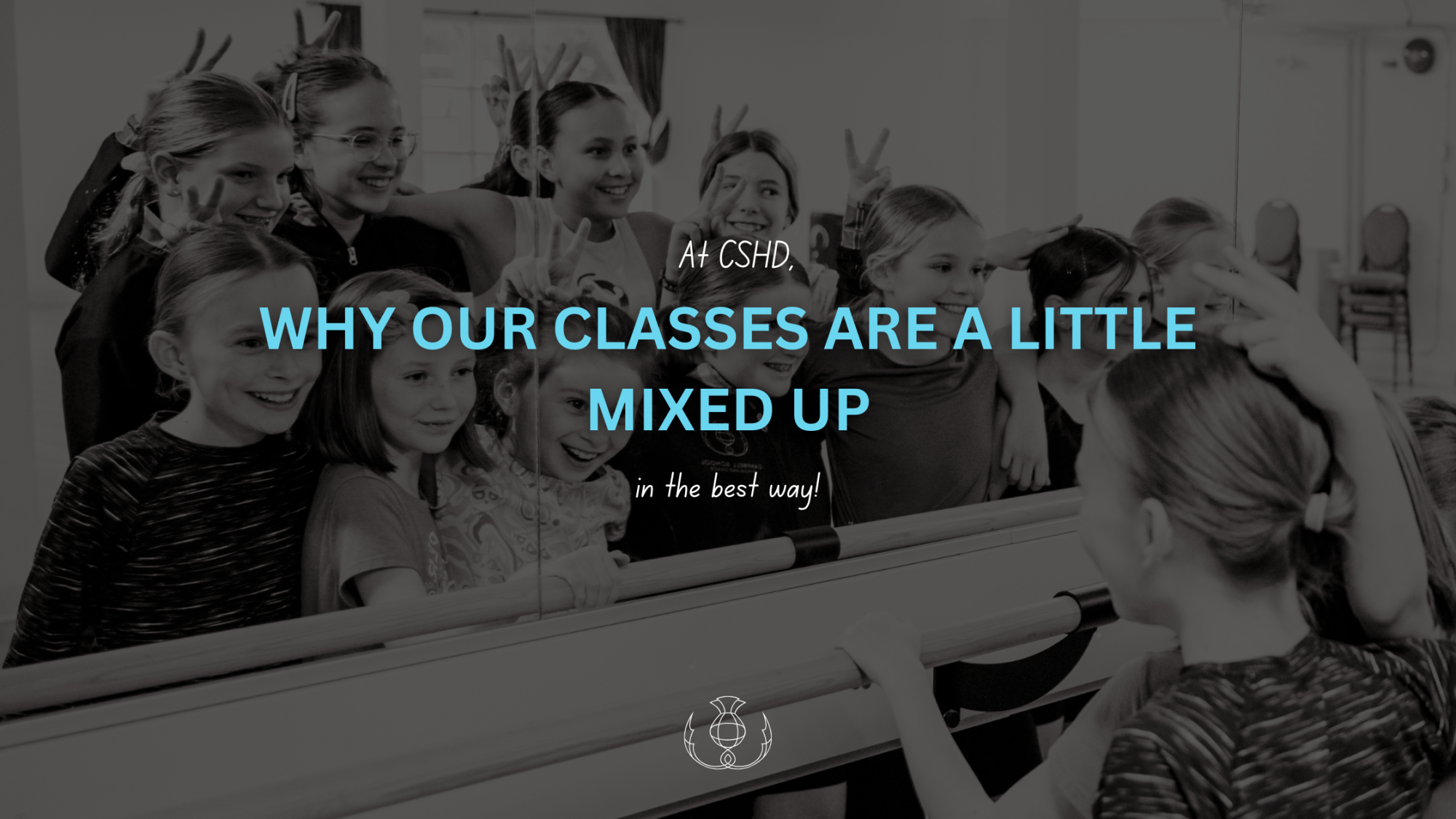
Dance classes looked a little mixed up.
We do this intentionally and love the effects from doing so. It’s not uncommon to see older dancers tying the ghillies of a younger one. Or, a confident, seasoned dancer showing a first year a step off to the side during down time. Sometimes our adult dancers choose to go a beginner class just to get some extra time working on the basics.
And every time we see something like that, we can’t help but smile, because building a community that brings people together while helping reach their personal goals is exactly what we want to be doing.
We choose to mix up our classes in multiple ways – mixed ages, levels, abilities – because we believe it creates a special type of environment that is beneficial for all. The best part about it all is that this philosophy is backed by science. Here’s a link to a peer reviewed study about the power of mixed-age play. And while dancing may not be exactly equated to play, they have enough similarities (creativity, self-expression, physical coordination, learning through mistakes, repetition and adjustments, etc. etc. etc.) that we’re happy to deduce that if it works for play, it’ll work for dance!
Here’s a deeper look into why mixing classes works so well for us.
Growth Isn’t Linear or Chronological
Children (and adults for that matter) develop their physical, mental, and emotional abilities at wildly different rates, and skill development in dance is equally varied. When classes are sorted strictly by age or level, it assumes that everyone progresses in the same way and we just can’t get behind that.
Leadership Develops Naturally
One of the best things about mixed classes is what happens to the dancers who are more ‘advanced.’ They automatically rise up to the leadership challenge.
In a mixed setting those that can (and want) to push themselves can, and those that are newer, or physically need adaptations, also can.
When an experienced dancer helps someone new, a bunch of cool things happen: they reinforce their own learning, they start to see themselves as an ‘expert’, and they usually tend to show their best dancing because they get a little bit of a chance to show off. All good things that make their own dancing better!
Research consistently shows that teaching others deepens understanding. It builds confidence, communication skills and emotional intelligence.
So, not only are we seeing dancing skills get honed, but the characteristics of strong and capable leaders too!
Newer Dancers See What’s Possible
Proximity to someone hardworking is powerful. Sure, you can tell a group of newer dancers that they should push themselves. OR you can put a few dancers who are showing hard work and the echoing naturally follows. The newer dancers sometimes don’t even notice that they are working harder, or in some cases you can actually see the glint in their eyes as they watch a role model and then try it themselves.
When newer dancers train beside those ahead of them, they see what’s possible and it turns theoretical technical corrections into tangible goals.
Life Isn’t Set up by Age or Ability, so why Should Dance?
Life is mixed in almost every facet. Adults often work with people of a hugely varied age range, or are on volunteer boards with people of varying skill level. It’s not like School Council is only for parents aged 32 with 2 children and 2 years experience.
Lots of youth sports teams also work like this, so why not dance classes too?
Learning to dance with people who move differently, learn differently or progress at a different pace builds empathy, cooperation and adaptability. It also strengthens resilience and social awareness, not to mention building the strong community we always harp on about.
What This Means for Our Dancers
Our hope is that by creating this dynamic space with lots of different ages, abilities, and goals, every dancer is inspired to reach their own best dancing, whatever that looks like. When we give this opportunity, we’re hoping that dancers:
- Gain empathy for those around them
- Take on leadership roles naturally
- Feel empowered to pursue their own goals
- Support classmates through successes, failures, and setbacks
- Take initiative to strengthen the community around them
Even though Highland dance is about coming to class to develop your dance ability, that’s not the only thing that matters and it would be silly to pretend otherwise. To us, who you become as a person is just as important (even more important, let’s be honest) as the dancer you become. We want dancers to leave us knowing how to do a killer sword, and also how to be a great human.
View our Spring Class Schedule to find the dance class that is right for you!